Recently, my post has been more to female hair loss. I must admit, as a man, I do not know much of female hair loss well enough. Female hair loss is considered more complicated as the hair thinning process is not concentrated in certain spot. Male pattern baldness normally start on hair thinning in vertex and frontal.
I would said, male pattern baldness battle is easier than female hair loss battle. WHY? Female pattern hair loss only can use Rogaine or minoxidil 2 %. Male can use minoxidil 5% and Propecia or Proscar. I always stress if a man want to choose minoxidil and propecia, choose propecia as it control DHT that result of male pattern hair loss.
Last week, a reader, Khairul said he split Proscar into 5 pieces. If you are reading this, please teach me splits the little Proscar into 5 pieces. I am currently split into 4 pieces. It is better to consume 1mg rather than 1.25mg right?
For those who purchase minoxidil online, grab the chance hen Ringgit is appreciate against US dollar. It si much cheaper now.

Sunday, May 9, 2010

Monday, May 3, 2010
Weekly summary - 137th week -- effectiveness of minoxidil 2%
2% percent topical Minoxidil is the only currently FDA-approved agent for female pattern hair loss, having shown efficacy over placebo in many trials.
In the evaluation of female pattern hair loss using hair counts as a primary endpoint, studies have shown a mean increase in hair growth of 15–33% in the Minoxidil-treated groups compared with 9–14% in the vehicle control groups. One small study using hair weight as the endpoint found an increase of 42.5% in hair weights in the Minoxidil group compared to 1.9% in the controls. In the investigator and subject assessments, Minoxidil was superior to the vehicle but about 40% of subjects appeared not to respond to Minoxidil. None of these trials were extended beyond 32 weeks and the long-term results of Minoxidil treatment are uncertain. In men the beneficial effects on hair growth are lost rapidly on cessation of treatment and it is most likely that the same holds true in the case of women as well.
One milliliter (25 drops) of Minoxidil solution must be used twice daily, in order to be effective. The drops must be applied directly onto a dry scalp and then slightly spread with the fingers. No more than 2 ml should be applied every day, regardless of the extent of the affected area. The best way for application is to make 5 partings in the hair and to put 5 drops in each part.
Minoxidil is poorly absorbed after topical application on normal intact skin, and only 0.3 to 4.5% reaches the systemic circulation. The percentage of Minoxidil that is absorbed is eliminated within 4 days. The effects on absorption of concomitant occlusion and the systemic metabolic biotransformation of topically applied Minoxidil are mostly unknown.
The most common Minoxidil side effects are simple contact dermatitis (scalp irritation, dryness, itching, scaling, and redness). 3 to 5% of women of women using Minoxidil develop hypertrichosis, a side effect of Minoxidil that is usually not perceived as a problem in men.
It is not clear yet why the hypertrichosis occurs but it is possibly through either a systemic effect or via a transfer of the drug, there is unwanted growth of hair affecting mostly the forehead, malar areas, and sides of the face. Hypertrichosis may diminish with continued treatment over the course of a year, and resolves completely within a few months once treatment is stopped. Pre-existing facial hair, higher dosing, and age older than 50 years are predisposing factors for hypertrichosis. Care also should be taken to avoid manual or fomites (e.g., pillows) spread of Minoxidil to sites other than the scalp, although the effect is largely believed to result from local absorption.
Studies have never shown any change in blood pressure or any other systemic effect, but Minoxidil solution should be used with caution in patients with cardiovascular disease.
Minoxidil should not be used in pregnant or nursing women. There is no evidence of teratogenicity in rats and rabbits, but Minoxidil has been found to be secreted in breast milk
You judge yourself whether You want to try Minoxidil 2%, but I would said it should be a safe bet.
- In a well-designed 32-week study, investigator global assessment determined that the application of 2% Minoxidil twice-daily stimulated mild to moderate re-growth in 63% of 157 women compared with 39% of 151 women treated with vehicle.
- In a 32-week trial of 256 women aged 15 to 45 years with Ludwig I or II alopecia, non-vellus hair counts on the top of the scalp showed a mean increase of 14 percent over baseline for those on 2% topical Minoxidil as compared with 7.3 percent for those on placebo.
- Similarly, a 32-week, double-blind, placebo-controlled trial was conducted in 10 European centers to assess the efficacy and safety of 2% topical Minoxidil solution for the treatment of androgenetic alopecia in women. The results showed that in the 2% Minoxidil group, the mean increase in non-vellus hair count was 33 hairs, which was significantly greater than that of 19 hairs in the placebo group. New growth was seen by investigators in 44 percent of those treated with topical Minoxidil vs. 29 percent of those on placebo, leading to the conclusion that topical Minoxidil solution was significantly more effective than placebo in the treatment of androgenetic alopecia in women.


In the evaluation of female pattern hair loss using hair counts as a primary endpoint, studies have shown a mean increase in hair growth of 15–33% in the Minoxidil-treated groups compared with 9–14% in the vehicle control groups. One small study using hair weight as the endpoint found an increase of 42.5% in hair weights in the Minoxidil group compared to 1.9% in the controls. In the investigator and subject assessments, Minoxidil was superior to the vehicle but about 40% of subjects appeared not to respond to Minoxidil. None of these trials were extended beyond 32 weeks and the long-term results of Minoxidil treatment are uncertain. In men the beneficial effects on hair growth are lost rapidly on cessation of treatment and it is most likely that the same holds true in the case of women as well.
One milliliter (25 drops) of Minoxidil solution must be used twice daily, in order to be effective. The drops must be applied directly onto a dry scalp and then slightly spread with the fingers. No more than 2 ml should be applied every day, regardless of the extent of the affected area. The best way for application is to make 5 partings in the hair and to put 5 drops in each part.
Minoxidil is poorly absorbed after topical application on normal intact skin, and only 0.3 to 4.5% reaches the systemic circulation. The percentage of Minoxidil that is absorbed is eliminated within 4 days. The effects on absorption of concomitant occlusion and the systemic metabolic biotransformation of topically applied Minoxidil are mostly unknown.
The most common Minoxidil side effects are simple contact dermatitis (scalp irritation, dryness, itching, scaling, and redness). 3 to 5% of women of women using Minoxidil develop hypertrichosis, a side effect of Minoxidil that is usually not perceived as a problem in men.
It is not clear yet why the hypertrichosis occurs but it is possibly through either a systemic effect or via a transfer of the drug, there is unwanted growth of hair affecting mostly the forehead, malar areas, and sides of the face. Hypertrichosis may diminish with continued treatment over the course of a year, and resolves completely within a few months once treatment is stopped. Pre-existing facial hair, higher dosing, and age older than 50 years are predisposing factors for hypertrichosis. Care also should be taken to avoid manual or fomites (e.g., pillows) spread of Minoxidil to sites other than the scalp, although the effect is largely believed to result from local absorption.
Studies have never shown any change in blood pressure or any other systemic effect, but Minoxidil solution should be used with caution in patients with cardiovascular disease.
Minoxidil should not be used in pregnant or nursing women. There is no evidence of teratogenicity in rats and rabbits, but Minoxidil has been found to be secreted in breast milk
You judge yourself whether You want to try Minoxidil 2%, but I would said it should be a safe bet.
Monday, April 26, 2010
Weekly summary - 136th week -- A new way to control hair loss??
I may be still long way to go for us. Anyway, it is a good sign besides Propecia that affects our body hormones it controls DHT. Now a new way by scientist but it may need years to come out something to control hair loss without interfere male hormone.
 A research team that includes investigators from Colombia, Rockefeller and Stanford Universities, believe they have found a gene that impacts hair growth.
The gene that was identified is APCDD1 (adenomatosis polyposis down-regulated 1). This gene is involved in the progressive hair loss condition referred to as hereditary hypotrichosis simplex and it is a condition that usually presents itself in childhood. Hereditary hypotrichosis simplex is a rare autosomal dominant form of hair loss which is characterized by hair miniaturization, a process in which thick terminal hair is replaced with finer hair over time.
The discovery of this gene is an incredible break in the world of hair loss since male pattern baldness also presents itself in the same way with miniaturizing hair follicles. This finding may certainly have a impact on future research and treatments for androgenetic alopecia and other forms of hair loss.
 Ultimately, this is another valued piece of a very complex puzzle that will allow greater insight into the process of follicle miniaturization. Angela M. Christiano, Ph.D., professor of dermatology and genetics & development at Columbia University Medical Center, and lead author of the study says
http://www.nature.com/
Scientists Identify New Hair Loss Gene – APCDD1
A research team that includes investigators from Colombia, Rockefeller and Stanford Universities, believe they have found a gene that impacts hair growth.The gene that was identified is APCDD1 (adenomatosis polyposis down-regulated 1). This gene is involved in the progressive hair loss condition referred to as hereditary hypotrichosis simplex and it is a condition that usually presents itself in childhood. Hereditary hypotrichosis simplex is a rare autosomal dominant form of hair loss which is characterized by hair miniaturization, a process in which thick terminal hair is replaced with finer hair over time.
The discovery of this gene is an incredible break in the world of hair loss since male pattern baldness also presents itself in the same way with miniaturizing hair follicles. This finding may certainly have a impact on future research and treatments for androgenetic alopecia and other forms of hair loss.
Ultimately, this is another valued piece of a very complex puzzle that will allow greater insight into the process of follicle miniaturization. Angela M. Christiano, Ph.D., professor of dermatology and genetics & development at Columbia University Medical Center, and lead author of the study says“This discovery was made by analyzing genetic data from a few families in Pakistan and Italy with hereditary hypotrichosis simplex. Through their analysis the research team found a common mutation in the APCDD1 gene that is located on a specific region of chromosome 18. Previous studies have shown chromosome 18 to be involved in other forms of hair loss including alopecia areata and androgenetic alopecia.”The researchers have determined that APCDD1 inhibits the signaling pathway (Wnt) that has been shown to control hair growth in mice.


“We have at last made a connection between Wnt signaling and human hair disease that is highly significant,” says Christiano. “And unlike commonly available treatments for hair loss that involve blocking hormonal pathways, treatments involving the Wnt pathway would be non-hormonal, which may enable many more people suffering from hair loss to receive such therapies.”This study can be found in the April 15 Edition of Nature.
“Furthermore, these findings suggest that manipulating the Wnt pathway may have an effect on hair follicle growth — for the first time, in humans,” said Dr. Christiano. “And unlike commonly available treatments for hair loss that involve blocking hormonal pathways, treatments involving the Wnt pathway would be non-hormonal, which may enable many more people suffering from hair loss to receive such therapies.
http://www.nature.com/
Subscribe to:
Posts (Atom)
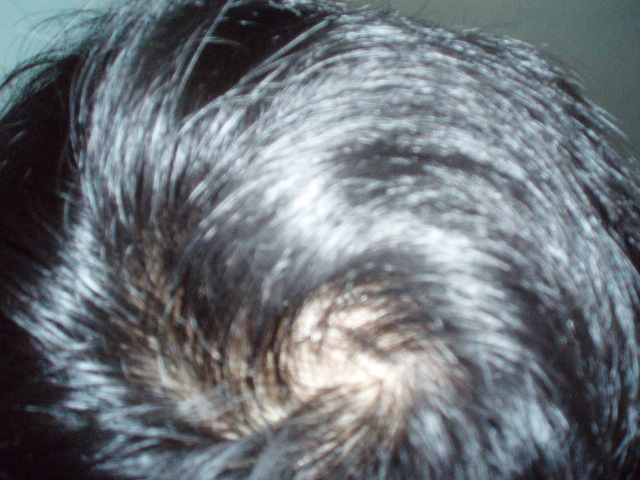
My hair condition (2 weeks after Propecia)
Frontal M shape
